Learn More About the Herpetology Collection
The Herpetology Collection represents decades of scientific discovery, fieldwork, and curatorial stewardship, and this resource hub brings those stories together in one accessible place. Here you’ll find an overview of the collection’s history—from its earliest specimens to the research that continues to shape our understanding of amphibians and reptiles today. We also highlight the curators, researchers, and staff whose work has guided the collection’s growth, including a look back at former curators who helped define its direction.
In addition to historical context, this page features selected articles, research stories, and scientific insights that showcase the collection’s ongoing impact. You’ll also find an archive of publications and research materials for deeper study. For those interested in supporting the collection’s future, we’ve included information on how financial contributions help preserve specimens, fund research, and expand our scientific reach. Explore the sections below to learn more about the people, scholarship, and legacy behind the Herpetology Collection.

History of the Collection
Specimens in the herpetology collection date back to as early as 1903, though at the time they were part of the larger vertebrate zoology collections…
Read More
Prior to 1949, all zoology specimens were cataloged together. Afterwards, however, the reptile and amphibian collections were each given their own set of numbers starting with 26000.
Collection growth continued thanks to statewide trips by Arthur Ortenburger, Ph.D. and others in the 1920s and 1930s. Zoology professors and graduate students of the University of Oklahoma also directed collecting during this time.
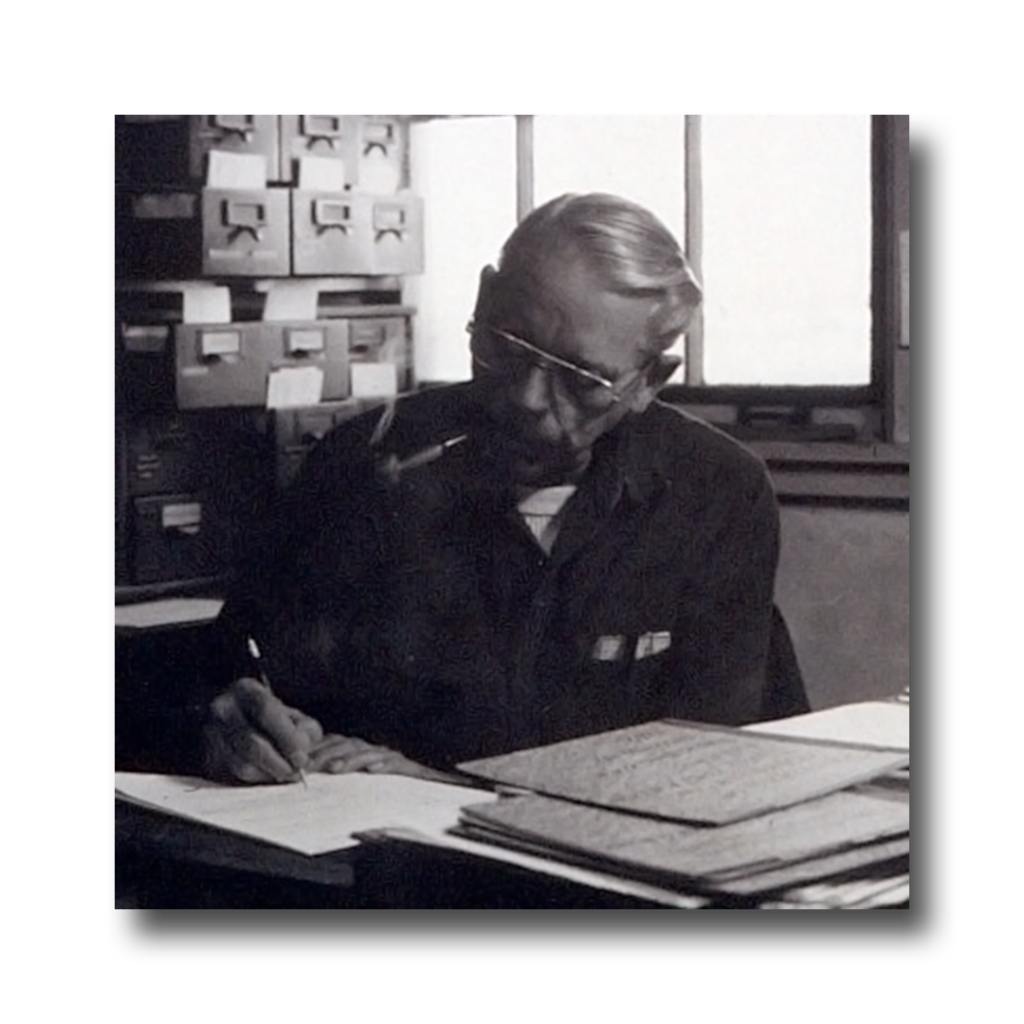
The first curators of herpetology were Arthur Bragg, Ph.D. (amphibians: 1934–68) and, pictured left, Charles Carpenter, Ph.D. (reptiles: 1953–68; all herpetology: 1968–87). Hired as professors, these herpetologists were only able to curate the collection as time permitted. In 1991, Laurie J. Vitt, Ph.D. (reptiles) and Janalee P. Caldwell, Ph.D. (amphibians) were hired with joint appointments as professors in the department of zoology and curators in herpetology.
Vitt and Caldwell retired from the museum in late 2011. The first full-time collection manager was hired in 2000, when all collections were moved to the current facility. Cameron D. Siler, Ph.D., was hired as the Curator of Herpetology in August 2013, and remained in the position until 2025. The collection now preserves a total of over 58,000 specimens.
News and Research – Herpetology
Learn more about the herpetology collection’s community involvement and research over the years, and discover how researchers, students and citizens make an impact by supporting the conservation of local amphibians, reptiles and ecosystems.
Undergraduate Students Publish Research Articles in Museum-Led Biology Course (2016)
NORMAN, OK – Students get an unexpected, eye-opening experience in biology — and become published authors — thanks to an OU biology course.
Read More
Brandon Heitz is on the road to a career in sports administration, but that didn’t stop him from enrolling in an undergraduate biology course that put him face to face with snakes, frogs, lizards and a slew of other amphibians and reptiles. Along with his classmates, Heitz authored and published species descriptions for three Philippine lizards — a responsibility not typically entrusted to undergraduates.
Heitz, who has since graduated from the University of Oklahoma with a degree in biology, opted for an immersive and hands-on class with Cameron Siler, Ph.D., the Sam Noble Museum of Natural History’s assistant curator of herpetology and assistant professor of biology at OU, in spring 2015. Like many students in the class, Heitz didn’t plan for a career working with creatures that shimmy and slither, and he never imagined he’d co-author a professional manuscript describing a new species, but he says he’s all the better for it.
“This shows you’ve had a unique experience, no matter what field you’re going into,” he said.
That was one of the goals, Siler explained. He wanted to give his students — many of whom are in a pre-medicine or pre-veterinary track — an unexpected, eye-opening experience in biology that they couldn’t get anywhere else. That’s why he split his class into three teams to tackle species descriptions for three Philippine lizards discovered by museum researchers and housed in the museum’s herpetology collection.
“This herpetology research provides them a really neat opportunity to not only get out in the field and explore, but to do real research and follow through on a project that would end in a publication for them,” Siler said. “This exposes them to the scientific writing process and peer review, and without this, they’d have no exposure to this kind of experience.”
The groups, each composed of about seven students, were tasked with researching their respective species, all in the genus Brachymeles and part of a species complex of small, stub-limbed burrowing skinks from Lubang Island, the northern Philippines and Tablas Island. They met deadlines throughout the semester, attended lectures about writing mechanics, created outlines for their projects, attended labs to examine the species and describe their holotype specimen, named the new species, and went through the peer review process.
One student even created scientific illustrations for all three species using a Wacom tablet and Adobe Illustrator software, based on specimen photos taken on the StackShot photo system used by the museum’s invertebrate paleontology collection.
Over the summer, all manuscripts were published in the peer-reviewed scientific journal Zootaxa and are now available for anyone to view online, thanks to support from the National Science Foundation and OU’s Office of the Vice President of Research. This kind of research, made possible through a current National Science Foundation grant, fits perfectly into the university’s mission to enhance undergraduate research across campus, Siler said.
The published species descriptions also benefit the Sam Noble Museum because students were able to chip away at the herpetology department’s queue of species that were waiting to be described.
“We find this new diversity and we end up sitting on stuff in a backlog because we just can’t work quickly enough to have everything described,” Siler said.
For Josh D. Kouri, a senior biology major, the undergraduate research experience will help propel him toward a career as a wildlife biologist. Kouri, who is applying for graduate schools, can show he’s a published author who understands the process of writing a scientific paper.
“I was so excited when I learned I’d get to publish a new species description as part of Dr. Siler’s class,” he said. “I don’t think many professors would be willing to let undergrads be equal contributors on a paper like this, let alone provide as much help and mentorship as Dr. Siler did.”
Not only that, but the project instilled confidence in him and his ability to complete his graduate school work.
“My experience in this project really underscored how much I enjoy learning about the amazing wildlife we share the planet with,” Kouri added. “There are so many incredible creatures just waiting to be discovered. Writing new species descriptions is the first step in ensuring our planet’s amazing diversity can be protected for generations to come.”
Elyse Ellsworth, who graduated from OU in May 2016 with a degree in biology, said the experience will give her a leg up applying for graduate schools and prepared her for the kind of work she’ll do in grad school.
“It opened the door to say, ‘OK, this is how you do real science. This is how you do a professional paper. This is how to get ahead of the game,’” Ellsworth said. “You can do these things before you actually get into grad school and it’s time to publish that big grad school project.”
And for Heitz, he was amazed that he and his classmates had no guarantee their hard work would be published — and that’s a reality for any researcher who writes a scientific paper for publication.
“We stepped into the role of writing, field collection and determining that these papers should even be written. … Just the fact you’ve done all the steps and you still have to sit and cross your fingers that it’s accepted somewhere — that was definitely an eye-opening experience to me on how academia works,” he said.
Jessa Watters, collection manager for the herpetology department, worked with Siler and his class and was pleased to help offer a career-advancing opportunity to students that also was built into their coursework.
“I think doing it through a class makes it even more special in some ways, because they got to do something while also getting credit that they needed to graduate.”
Research Loans and Policies – Herpetology
Are you interested in borrowing a specimen from the museum’s herpetology collection for research or study? Learn more about how to process a specimen loan below.
Learn More
Loan Requests
Individuals who would like to borrow from the museum collection will be required to sign and return a loan agreement/invoice and a condition of loan form upon receipt of the specimens.
Emailed loan requests should be sent to a current member of the collection staff. Mailed loan requests should be sent to:
Herpetology Division
Sam Noble Museum
2401 Chautaaqua Ave.
Norman, OK 73072
All specimen loans must requested in writing, via a formal written letter providing the following information:
- Your name, affiliation, and contact info
- Scope of the project, including proposed use of specimens
- Timeframe of the project/loan
- Expected results/products/manuscripts of the project
- List of specimens and OMNH catalog numbers you are requesting
For students only:
- The name, affiliation, and contact info of your advisor/supervisor
- Their signature on your written request
Herpetology Archives
The herpetology department maintains detailed archives of all their specimens. This includes handwritten specimen tags, jar labels, field notebooks, and distribution maps. Herpetology also stores original and digitized videos (e.g. behavioral assays, habitat, field trips) by Charles C. Carpenter, PhD (and his graduate students) and frog call recordings by Janalee P. Caldwell, PhD.
See below for a historic list of archived field notes scanned as PDF documents which are available by request and approval. Please Contact Us if you would like to request access to our archives.
Archival Records
Royce E. Ballinger (1991-2000)
Matthew C Brandley (2000-2002)
Janalee P. Caldwell (1965-2008)
Jeffrey D. Camper (1992-1993)
Charles C. Carpenter (1953-1987)
- Distribution Maps (Oklahoma only)
- Research Notes & Illustrations
- Safaris (field collecting trips)
- Species Accounts
Timothy J. Colston (2008-2009)
Richard D. Durtsche (1993)
Amy D. Estep (2000-2004)
Dante B. Fenolio (1999)
April K. Fink (2008-2009)
Beryl Freeman (1926)
M. D. Halcomb (1932)
Joel A. Johnson (2000-2001)
Ricky G. Jones (1984)
O. M. King (1953-1959)
James Lazell (2000-2002)
William I. Lutterschmidt (1995)
John H. Malone (1999-2002)
Supporting the Herpetology Collection
Are you interested in supporting the museum? By donating to the Herpetology Department, you help us study and conserve the natural world. Any dollar amount helps the museum continue to serve the people and wildlife of Oklahoma.
This fund provides support for operations within the Herpetology Department’s collection and research by museum curators, staff, and students.